SELECTED CASE STUDY
TECH STACK
Angular, .NET
YEAR
2025
The Solution
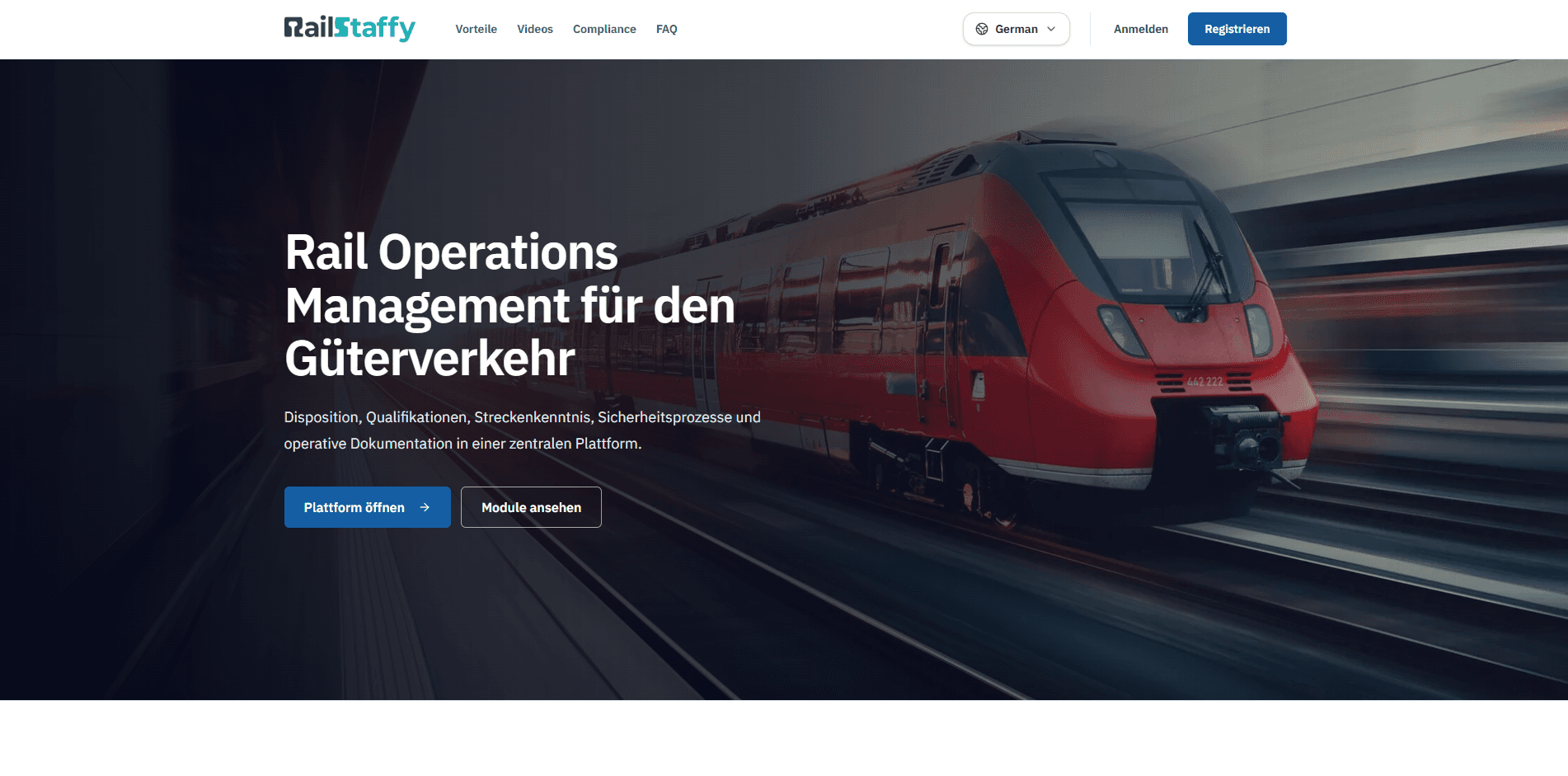
RailStaffy is a domain-specific digital operations platform designed for rail freight staffing, qualification-safe dispatch and controlled transport execution.
The platform connects railway undertakings, staff agencies and train drivers within a shared operational environment while embedding qualification checks, safety-management processes, controlled documentation and traceable records directly into day-to-day workflows.
Rather than functioning as a simple staffing marketplace, RailStaffy brings together operational planning, compliance, communication, learning, finance and organisational governance in one integrated platform.
Multi-Role Operational Platform
Rail freight operations involve multiple organisations and user groups with different responsibilities, permissions and compliance requirements.
RailStaffy was designed around these boundaries from the beginning, providing dedicated workflows for:
Train drivers
Railway undertakings
Staff agencies
Safety and operational roles
Finance and accounting users
Platform administrators
Role-specific dashboards and controlled organisation boundaries ensure that each participant works with the information and functionality relevant to their responsibilities.
Qualification-Safe Dispatch
Assigning a train driver requires more than simply checking availability.
Before an assignment can be executed, the responsible organisation may need to verify licences, certificates, route knowledge, rolling-stock competence, working-time requirements and undertaking-specific safety conditions.
RailStaffy integrates these checks directly into the assignment process, helping organisations evaluate driver suitability before operational execution.
Qualification capabilities include
Licence and certificate management
Validity tracking and alerts
Complementary certificate registry
Route and infrastructure knowledge
Rolling-stock competence
Country-specific qualification information
Working-time related operational controls
Structured qualification history
This creates a more controlled dispatch workflow while reducing dependency on fragmented spreadsheets, documents and manual verification.
Assignment & Transport Workflows
The platform provides structured workflows for the complete assignment lifecycle.
Suitable assignments and transport offers can be created, discovered and matched across organisations, while users can track active, upcoming and historical assignments through dedicated operational views.
The solution supports:
Assignment marketplace workflows
Transport offers and matching
Applications and shortlists
Assignment creation
Dispatch processes
Check-in, departure, arrival and completion states
Operational issue handling
Assignment history and traceability
These workflows create a shared operational context for all involved participants.
Safety Management
Safety processes are embedded directly into normal operational workflows rather than managed as a separate administrative layer.
RailStaffy supports:
Individual safety briefings
Repetitive briefings
Real-time safety information
Driver feedback
Controlled safety documentation
Completion tracking
Undertaking-specific safety processes
Briefings and safety information can be issued to specific drivers and linked to operational activities, while completion and feedback remain traceable for later review.
This creates a structured connection between operational execution and safety governance.
Route Intelligence & Railway Network Mapping
RailStaffy includes railway-specific geospatial functionality directly inside the operational platform.
The route map integrates railway infrastructure data with platform-owned operational objects such as corridors, stations and assignment-related geography.
This supports:
Cross-border corridor planning
Station and route visualization
Route-knowledge workflows
Infrastructure-knowledge tracking
Geographic filtering
Corridor overlays
Operational route selection
The platform uses railway geodata as operational context rather than presenting mapping as a separate visualization layer.
Real-Time Communication
Operational coordination often requires immediate communication between drivers, agencies and undertakings.
RailStaffy includes a real-time communication layer supporting conversation history, messages, reactions, read receipts, typing indicators and participant activity.
The architecture uses SignalR for real-time events and can use Redis-backed shared state for multi-instance deployments, allowing the communication layer to scale with the platform.
This keeps communication connected to the underlying operational context instead of relying on disconnected external channels.
Learning & Competency Management
The platform also includes a virtual learning environment for qualification and competency-related activities.
Users can access:
E-learning courses
Assigned learning
Competency checks
Quizzes
Completion tracking
Controlled documents
Qualification-related training content
This allows learning, competence and operational eligibility to exist within the same governed environment.
Finance & Settlement Workflows
Operational execution is connected with structured financial workflows.
RailStaffy supports incoming and outgoing invoices, payout requests, settlement settings and transaction history, allowing financial administration to remain connected to the broader operational platform.
This reduces the need to maintain separate operational and financial coordination processes.
Security & Governance
Because RailStaffy operates across multiple organisations and operational roles, access control and traceability are core parts of the platform architecture.
The solution includes:
Two-factor authentication
Role-based permissions
Organisation-aware access boundaries
Sub-account management
Audit-ready operational records
Controlled impersonation for administration
Request rate limiting
Secure token handling
Environment-specific configuration
Operational actions can be governed by predefined permissions, checks and approval rules while relevant changes remain structured for later review.
Application Architecture
RailStaffy is built as a modern web application with an Angular frontend and a .NET / ASP.NET Core backend, supported by PostgreSQL for transactional persistence and Redis for shared state and caching.
The backend is organised around bounded business domains so that operational, compliance, finance and administration workflows remain independently maintainable, while the Angular frontend provides role-specific interfaces for drivers, railway undertakings, agencies and specialist operational users.
Key platform technologies include:
Angular
.NET / ASP.NET Core Web API
Entity Framework Core
PostgreSQL
Redis
SignalR
Hangfire
JWT-based authentication
OpenAPI / Swagger
Real-time communication is handled through SignalR, while background processing supports retryable asynchronous workflows such as notifications and email delivery.
Built for Regulated Operations
RailStaffy was designed as an operational platform for an environment where assignments, qualifications, safety processes and organisational responsibilities need to remain structured and traceable.
By combining dispatch, qualification management, safety workflows, controlled documentation, learning, communication and financial processes, the platform replaces fragmented operational coordination with a single governed digital environment.
The result is a system that supports both day-to-day operational efficiency and long-term compliance-oriented traceability.
WebQuest delivered RailStaffy as a domain-specific digital platform demonstrating complex workflow engineering, multi-role governance, compliance-oriented architecture and regulated-industry delivery.

[Explore]